3 Essential Points to Consider When Comparing Australia Vs the United States for a Student Visa or Work Permit Visa in 2025
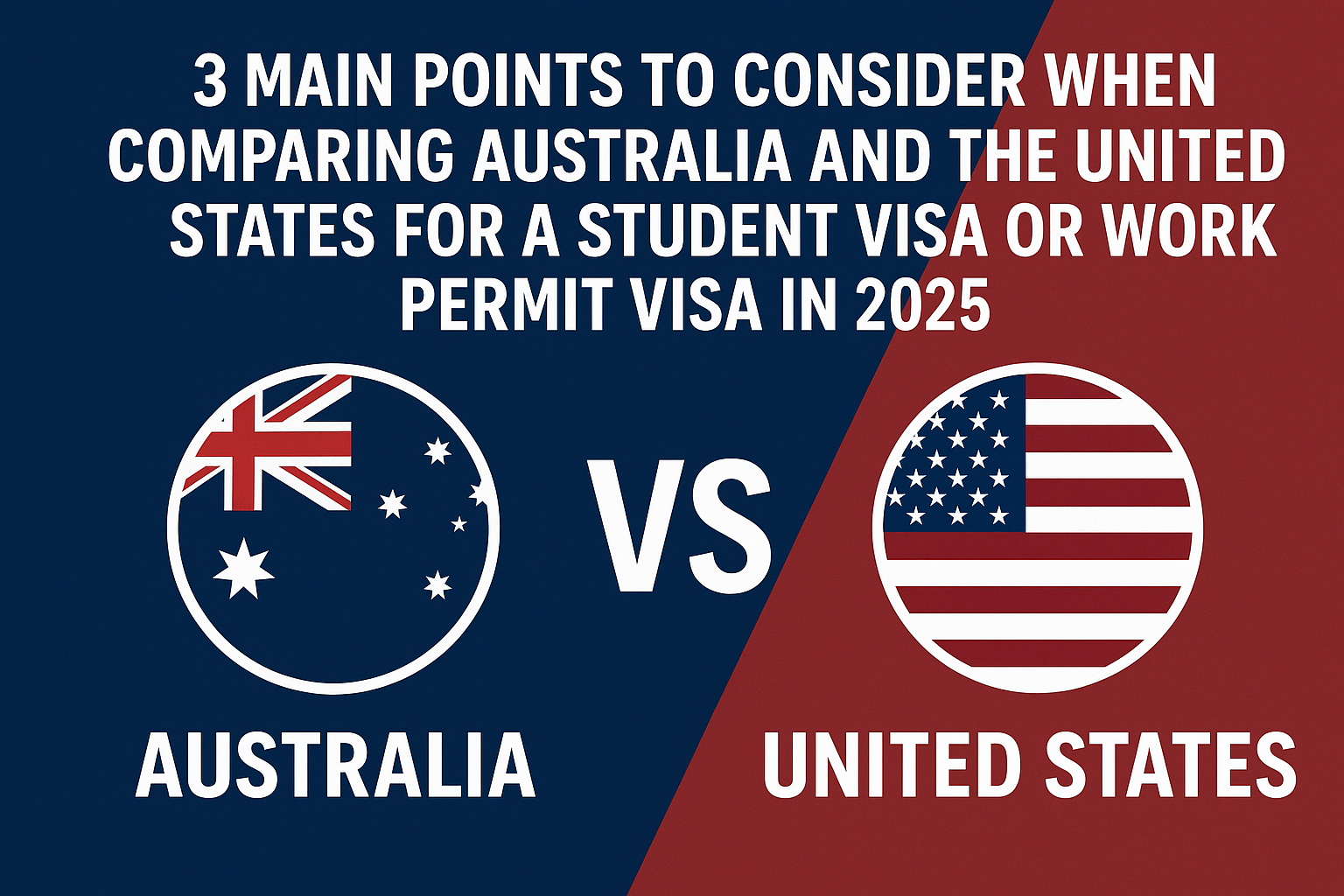
Australia vs USA student visa 2025
3 Essential Points Points to Consider
When Comparing Australia and the United States
for a Student Visa or Work Permit Visa in 2025
Introduction
If you’re planning to study or work abroad in 2025, two of the most popular destinations on your list are likely Australia and the United States.
Both countries offer world-class education, diverse job opportunities, and vibrant multicultural environments.
But choosing the right destination for your student visa or work permit visa can feel overwhelming.
Here are three main points to compare before you take the leap.
1. Visa Policies and Post-Study Work Rights -Australia vs United States student visa 2025
Visa rules can significantly affect your long-term plans.
-
Australia: https://immi.homeaffairs.gov.au/visas/getting-a-visa/visa-listing
-
The Student Visa (Subclass 500) is known for its straightforward process, with clear requirements for funds, English proficiency, and health checks.
-
Once you finish your studies, the Temporary Graduate Visa (Subclass 485) allows you to stay and work for 2–4 years, depending on your qualification level.
-
Regional study areas can even grant extended work rights and extra points if you plan to apply for permanent residency later.
-
United States:
-
The F-1 Student Visa provides Optional Practical Training (OPT) for up to 12 months after graduation, with an extension of up to 36 months for STEM graduates.
-
While U.S. universities are prestigious, transitioning to a work visa such as the H-1B can be challenging.
-
The H-1B is a lottery-based system, meaning even qualified candidates may not secure a visa.
-
Permanent residency (Green Card) options are often lengthy and employer-dependent.
2. Education Quality and Career Prospects-Australia vs United States student visa 2025
Both countries are home to excellent universities, but their systems and career pathways differ.
-
Australia:https://www.idp.com/india/study-in-australia/regional-universities-in-australia/
-
Universities like the University of Melbourne, ANU, and the University of Sydney consistently rank among the world’s best.
-
Tuition fees are often lower than in the U.S., and the country has a high demand for skilled workers in healthcare, IT, engineering, and construction.
-
Choosing a regional university can be a smart strategy to boost your migration prospects while still receiving a quality education.
-
United States:
-
U.S. universities dominate global rankings, offering cutting-edge research opportunities and vast alumni networks.
-
The job market is diverse, with especially high demand in technology, finance, healthcare, and research.
-
Salaries can be lucrative, but visa uncertainty may affect long-term career stability.
-
If you’re willing to navigate the competitive visa process, the U.S. offers unmatched exposure to leading industries and innovation hubs like Silicon Valley.
3. Lifestyle, Cost of Living, and Immigration Pathways
Your day-to-day life and future residency options are just as important as your studies or job.
-
Australia:
-
Known for its laid-back culture and work-life balance, Australia offers a safe and welcoming environment for international students and workers.
-
Healthcare is reliable, and the minimum wage is among the highest in the world, helping offset the high cost of living.
-
Moreover, Australia’s points-based skilled migration program provides a clearer path to permanent residency, especially for those in high-demand fields.
-
United States:
-
The U.S. is culturally diverse, with exciting opportunities for personal and professional growth.
-
Cost of living varies significantly between states—cities like New York or San Francisco are expensive, while smaller towns or states like Texas may be more affordable.
-
Healthcare, however, can be costly without insurance. Long-term immigration can be uncertain unless you have employer sponsorship or family connections.
In Short…….
Choosing between Australia and the United States depends on your goals.
If you prioritize easier visa processes, clear post-study work rights, and a direct path to residency,
Australia may be the better option.
If top-tier education, global networking, and high-paying jobs in competitive industries excite you—and you’re prepared for visa challenges—the United States might be your perfect fit.
Both countries can open doors to a successful international career.
By weighing these three factors—visa policies, education and career opportunities, and lifestyle with immigration pathways—you can make a choice that aligns with your long-term dreams.
I truly appreciate your technique of writing a blog. I added it to my bookmark site list and will